2007.06.24
Yamanashi NichiNichi Shinbun
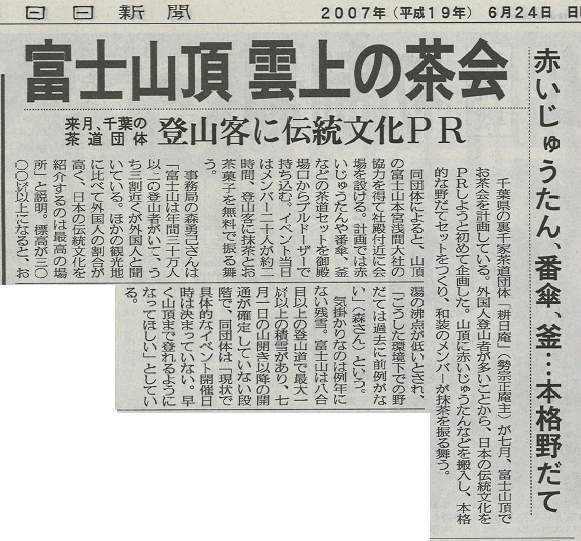
A Tea Ceremony Above the Clouds at the Summit of Mount Fuji
Chiba Tea Group to Promote Traditional Japanese Culture to Climbers Next Month
Kōjitsuan, a Urasenke school tea ceremony group from Chiba Prefecture, headed by tea master Sōshō Sei, is planning to hold a tea ceremony at the summit of Mount Fuji in July.
Because Mount Fuji attracts a large number of foreign climbers, the event has been organized for the first time with the aim of introducing and promoting traditional Japanese culture.
The group plans to transport a red carpet and other equipment to the summit, create a full-scale nodate, or outdoor tea ceremony setting, and serve matcha to visitors while dressed in traditional Japanese clothing.
According to the group, with the cooperation of Fujisan Hongū Sengen Taisha, which administers the area around the summit, a venue will be established near the shrine buildings.
The plan calls for tea ceremony equipment—including a red carpet, traditional bangasa umbrellas, and a kettle—to be transported from the Gotemba Trailhead to the summit by bulldozer.
On the day of the event, approximately 20 members of the group will serve matcha and Japanese sweets free of charge to climbers for about two hours.
Because the boiling point of water is lower at the summit, there is reportedly no previous example of a nodate tea ceremony being held under such conditions.
One concern, however, is the unusually heavy amount of snow remaining on the mountain this year.
On the trails above the eighth station of Mount Fuji, snow has accumulated to depths of more than two meters in some places, and at the time of the article the opening of the trails after the official climbing season begins on July 1 had not yet been confirmed.
The group therefore stated:
“At present, the date and time of the event have not yet been decided. We hope that climbers will soon be able to reach the summit.”
Yuki Mori, the group's administrative coordinator, explained:
“More than 300,000 people climb Mount Fuji every year, and I understand that nearly 20 percent of them are foreign visitors. Compared with other tourist destinations, the proportion of foreign visitors is particularly high, making Mount Fuji an ideal place to introduce Japan's traditional culture.”