2026.03.01
TokoTon Kazusa 83.4
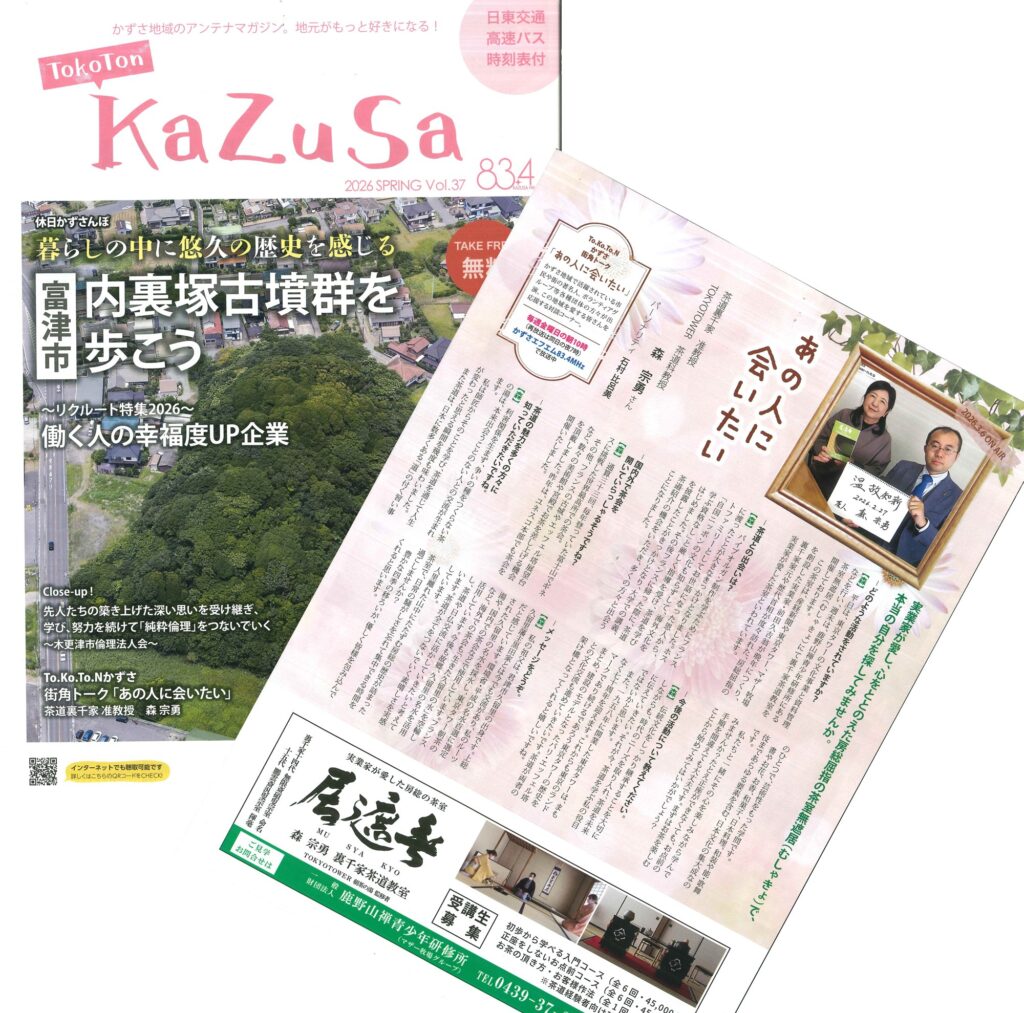
A free community newspaper published by a local radio station
I Want to Meet That Person
An interview with Tea Master Mori Soyu
Mori Soyu
Urasenke Tea Master, Associate Professor
Professor of Tea Ceremony at TOKYO TOWER
Discover Your True Self in Mushakyo, One of Boso's Most Distinguished Tea Rooms, Loved by a Businessman Who Cherished Tea and Used It to Bring Peace to the Mind
— What kind of activities are you currently involved in?
Mori:
On weekdays, I am involved in cultural programs and the management of historical materials at Tokyo Tower. On weekends, I hold Urasenke tea ceremony classes at Mushakyo, a tea room located at the Kaneyama Zen Youth Training Center.
This tea room was built in his later years by the late Hisakichi Maeda, the businessman who founded Sankei Shimbun, Tokyo Tower, and Mother Farm. It is said to be one of the most distinguished tea rooms in the Boso region, having been cherished by Maeda and visited on numerous occasions by successive heads of the Urasenke school and former prime ministers.
The tea room is filled with numerous elements of Japanese culture: calligraphy, flowers, incense, Japanese sweets, Japanese cuisine, kimono, Noh and Kabuki. In this sense, it can be regarded as a culmination of Japanese culture.
Why not experience the spirit of tea together with others, while enjoying the experience of learning?
Even if you cannot sit in the formal seiza position, or even if you make a mistake in the prescribed procedures of temae, that is perfectly all right. Why not begin simply by enjoying tea?
— How did you first encounter the tea ceremony?
Mori:
A major turning point came when I went to France to study pipe-organ making.
My host family there told me quite firmly:
“How can you expect to understand foreign cultures when you do not even know your own Japanese culture?”
Their words led me to begin studying the tea ceremony.
Later, when I returned to France, I had the opportunity to demonstrate the tea ceremony. This led to invitations to give university lectures and introduce Japanese tea culture, and through these activities I have had the privilege of meeting many wonderful people.
— You hold tea ceremonies both in Japan and overseas, don't you?
Mori:
I have held a total of 33 tea gatherings at Mount Fuji, including an attempt to set a Guinness World Record for a tea ceremony held at the world's highest altitude.
I have also had opportunities to serve tea at French châteaux, the Eiffel Tower observation deck, and numerous museums and palaces.
Last year, I held a tea gathering at UNESCO Headquarters as well.
— You would like many people to discover the appeal of the tea ceremony.
Mori:
That is something I learned from my own teacher. Through the tea ceremony, I have experienced many moments when I felt that my life had changed.
Chanoyu is one of the many traditional Japanese disciplines known as dō, or “the Way,” and it is also a discipline with a strong artistic dimension.
It encompasses an extraordinary range of Japanese culture, including calligraphy, flower arrangement, incense, traditional sweets, Japanese cuisine, kimono, Noh and Kabuki. In that sense, the tea ceremony is a culmination of Japanese culture.
Would you like to learn while enjoying that spirit together with other people?
Even if you cannot sit in seiza, or if you make mistakes in the procedures of temae, there is no need to worry. Why not begin simply by enjoying the tea?
— What are your plans for the future?
Mori:
I believe it is important to preserve traditional culture while also responding to the needs of the times, and I would like to continue communicating the spirit of tea.
Tokyo Tower will celebrate its 70th anniversary in 2028. From now on, I hope to incorporate the history of Tokyo Tower and develop it into a model of cultural exchange, together with the Paris Eiffel Tower.
I would be delighted if the tea ceremony could become a bridge between the two cultures.
— A message to our readers?
Mori:
My ancestor was from Kururi in Kimitsu City. We still have exchanges with the area today.
The water from Kururi, which was selected among Japan's 100 finest waters, is used for tea gatherings at Tokyo Tower, and we also use it when holding tea gatherings overseas.
I would like to continue making use of Kururi's famous water and sharing the beauty of its local culture through tea ceremony and Japan–France cultural exchange.
When you leave the city and enter the mountains, where the history of Boso has accumulated over centuries, you can forget the bustle of everyday life and spend time in peaceful concentration in the tea room.
Why not experience the gentle passage of the four seasons there, surrounded by warm hospitality?