2017.07.08
Ech Chaab
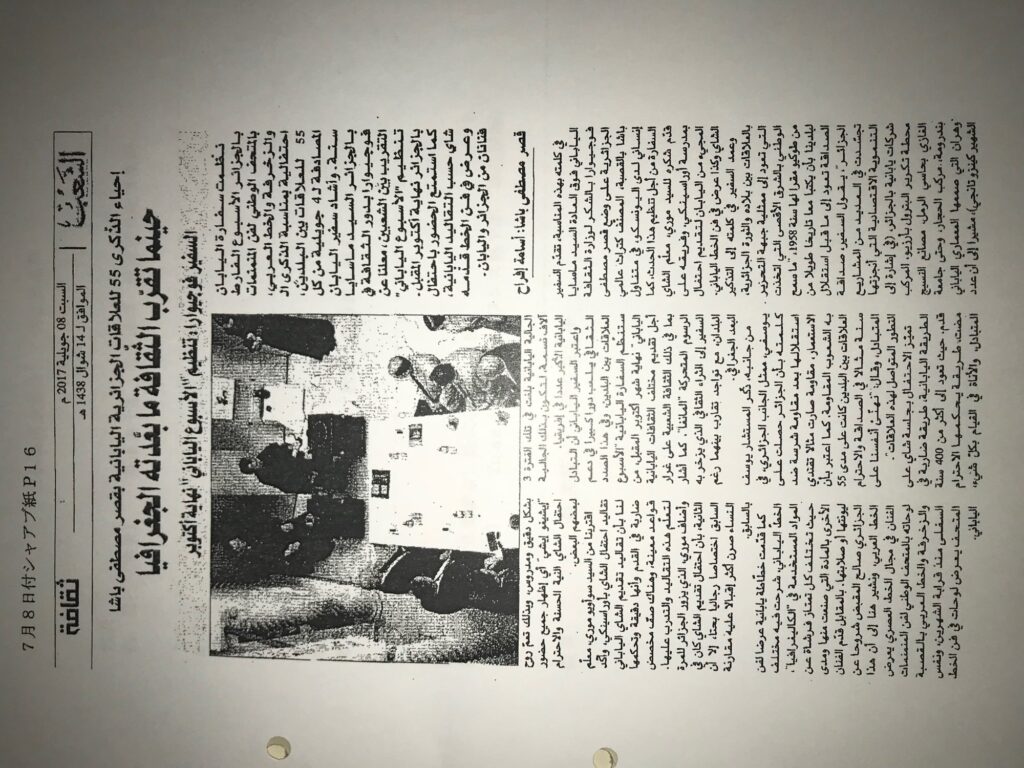
Commemorating the 55th Anniversary of Algerian-Japanese Relations at the Mustafa Pacha Palace
When Culture Brings Closer What Geography Keeps Apart
Ambassador Fujiwara to Organize “Japanese Week” at the End of October
The Embassy of Japan in Algeria organized an event last week at the National Museum of Miniatures, Illumination and Calligraphy in Algiers to commemorate the 55th anniversary of relations between the two countries.
The event coincided with July 4, the anniversary of the establishment of bilateral relations.
The Japanese Ambassador to Algeria, Masaya Fujiwara, emphasized the role of culture in bringing the two peoples closer together and announced that the embassy would organize a “Japanese Week” in Algeria at the end of October.
The guests also attended a traditional Japanese tea ceremony, as well as a demonstration of calligraphy presented by two artists from Algeria and Japan.
Mustafa Pacha Palace: Osama Ifrah
In his remarks on the occasion, Japanese Ambassador Extraordinary and Plenipotentiary Masaya Fujiwara expressed his gratitude to the Algerian Ministry of Culture for making the Mustafa Pacha Palace in the Casbah available to the embassy for the event.
The palace is listed as a UNESCO World Heritage site.
He also thanked Master Mori, a tea master of the Urasenke school, and his team for coming from Japan to present the tea ceremony and a demonstration of Japanese calligraphy.
The ambassador also recalled the historical relationship between Japan and the Algerian Revolution.
This relationship dates back to the Far East representation of the National Liberation Front (FLN), which established its headquarters in Tokyo in 1958.
“This enabled our two countries to write together a long history of friendship that goes back to before Algeria’s independence,”
the ambassador said.
This friendship has been embodied in numerous economic and development projects carried out by Japanese companies in Algeria.
Among them, the article mentions the oil refinery at Arzew, the gas complex at Hassi R’Mel, textile factories at Benderouma, the El Hadjar complex, and even the University of Oran, designed by the renowned Japanese architect Kenzo Tange.
The article also states that the Japanese community in Algeria reached approximately 3,000 people during that period, making it the largest Japanese community in Africa.
The Japanese ambassador emphasized that cultural exchange plays an important role in strengthening relations between the two countries.
In this context, the Japanese Embassy will organize “Japanese Week” at the end of October, presenting various aspects of Japanese culture, including popular culture such as manga and animation.
The ambassador also highlighted the rich cultural heritage shared by the two countries and the affinity between them despite the geographical distance separating them.
For his part, Counsellor Youssef Bousfi, representing the Algerian side, recalled in his speech that Algeria achieved independence after fierce resistance against colonialism, a resistance that became an example for other peoples fighting for their freedom.
He also considered the 55-year relationship between the two countries to be an example of friendship and mutual respect, saying:
“We congratulate ourselves on the continued development of these relations.”
The event also featured a Japanese-style tea ceremony.
The tradition is very old, dating back more than 400 years. It is governed by mutual respect and patience, with every action carried out carefully and precisely.
It also embodies the spirit of ichigo ichie, the idea that every encounter is unique and should be treated with goodwill and respect toward everyone taking part in the tea gathering.
The newspaper also spoke with Sōyū Mori, a tea master of the Urasenke school.
Mori explained that the traditions governing the preparation and serving of Japanese tea are very old and highly precise, with established rules. There are also dedicated classes where these traditions are learned and practiced.
Mori, who was visiting Algeria for the second time, added that tea ceremony had once been almost exclusively a male practice, whereas women are now increasingly interested in participating, compared with the past.
A Japanese calligrapher also gave a demonstration of Japanese calligraphy, explaining the various materials used in calligraphy. She explained that brushes differ according to the materials from which they are made and according to their flexibility or firmness.
Algerian artist Saleh Al-Maqbad gave an explanation of Arabic calligraphy.
The article notes that this artist, who works in the field of contemporary calligraphy, had been exhibiting his works for approximately two months at the National Museum of Miniatures, Illumination and Calligraphy in the Casbah.
The same museum was also exhibiting works of Japanese calligraphy.