2018.09.12
Cameroon Tribune
Japan–Cameroon Cooperation
Tea to Seal Friendship
The Ambassador of Japan to Cameroon presided over the “Japan Day” in Yaoundé last Monday, an event marked by the first tea ceremony organized in sub-Saharan Africa.
By Georges Emmanuel TSAYID
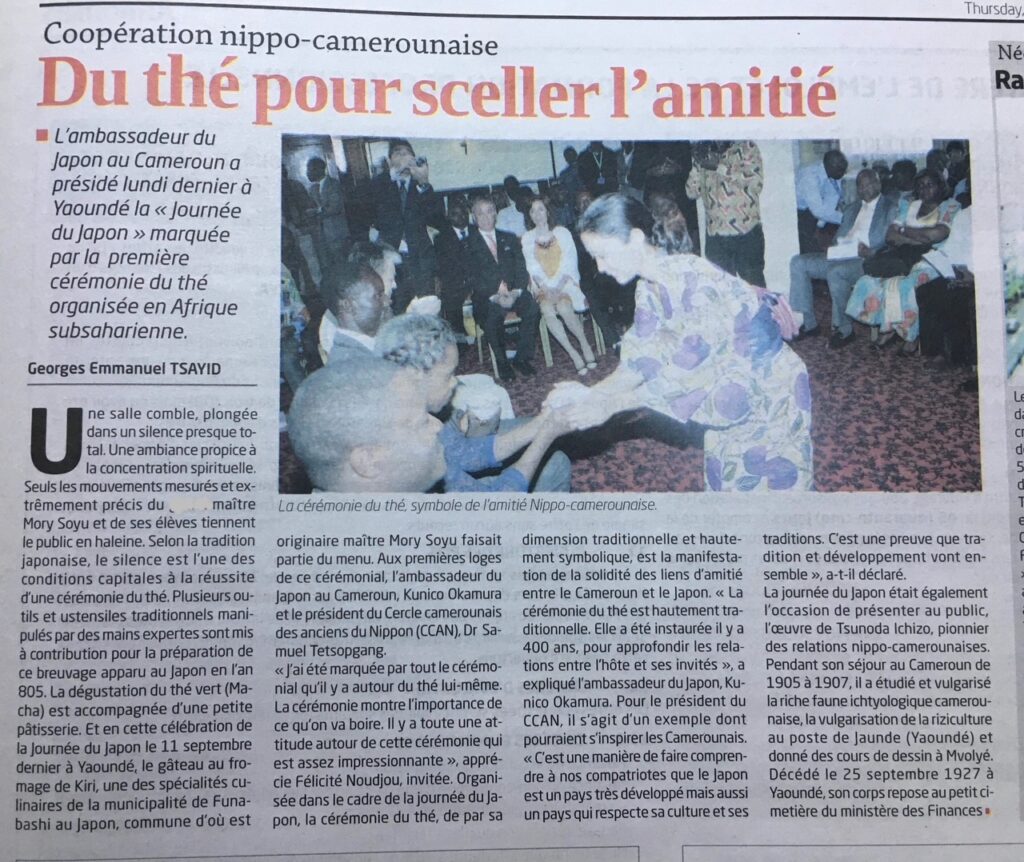
The hall was packed, enveloped in almost complete silence. The atmosphere was conducive to spiritual concentration. The audience watched attentively as tea master Mory Soyu and his students performed their measured and extremely precise movements.
According to Japanese tradition, silence is one of the essential conditions for a successful tea ceremony. Numerous traditional tools and utensils, handled by expert hands, are used in preparing this beverage, which is said to have appeared in Japan in the year 805. The tasting of green tea, or matcha, is accompanied by a small pastry.
At the celebration of Japan Day held in Yaoundé on September 11, the menu included Kiri cheesecake, one of the culinary specialties of Funabashi City in Japan, the city from which tea master Mory Soyu originates.
Among those seated at the front of the ceremony were Kunico Okamura, Ambassador of Japan to Cameroon, and Dr. Samuel Tsetsopang, President of the Cameroonian Circle of Friends and Former Students of Japan (CCAN).
Félicité Noudjou, one of the guests, remarked:
“I was struck by all the ceremony surrounding the tea itself. The ceremony shows the importance of what we are about to drink. There is an entire attitude surrounding the ceremony, and I found it quite impressive.”
Organized as part of Japan Day, the tea ceremony, through its traditional and highly symbolic character, demonstrated the strength of the bonds of friendship between Cameroon and Japan.
“The tea ceremony is deeply traditional. It was established about 400 years ago in order to deepen the relationship between the host and his guests,” explained Japanese Ambassador Kunico Okamura.
For the President of the CCAN, the ceremony provides an example from which Cameroonians could learn.
“It is a way of showing our fellow citizens that Japan is a highly developed country, but also a country that respects its culture and traditions. It is proof that tradition and development can go hand in hand,” he said.
Japan Day also provided an opportunity to introduce to the public the work of Ichizo Tsunoda, a pioneer of Japan–Cameroon relations.
During his stay in Cameroon from 1905 to 1907, he studied and promoted knowledge of Cameroon’s rich fish fauna. He also promoted rice cultivation at the Jaunde (Yaoundé) post and gave drawing lessons in Mvolyé.
He died in Yaoundé on September 25, 1927, and his remains are buried in the small cemetery of the Ministry of Finance.