2021.11.01
Edo-gaku Vol.151
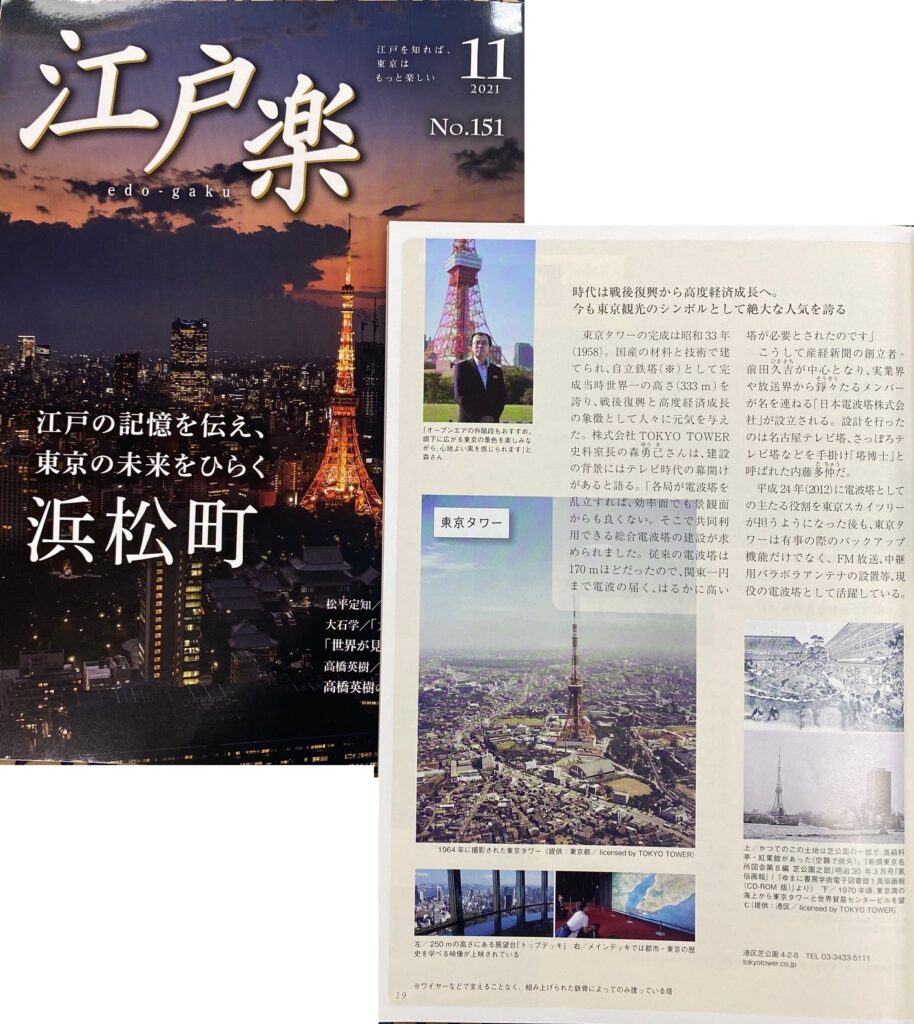
From Postwar Reconstruction to Rapid Economic Growth
Tokyo Tower remains one of the most popular symbols of tourism in Tokyo
Tokyo Tower was completed in 1958 (Showa 33). Built using Japanese materials and technology, it was, at the time of its completion, the world’s tallest self-supporting steel tower, standing 333 meters high. As a symbol of Japan’s postwar reconstruction and rapid economic growth, it gave people a sense of hope and vitality.
Yuuki Mori, Head of the Archives Department at TOKYO TOWER Co., Ltd., explains that the construction of Tokyo Tower was closely connected with the beginning of the television era.
“If each broadcasting station had its own transmission tower, it would not have been efficient, either operationally or from the standpoint of the cityscape. Therefore, there was a need to construct a comprehensive transmission tower that could be shared by multiple broadcasters. Conventional transmission towers were about 170 meters high, so a much taller tower was needed in order for signals to reach throughout the entire Kanto region.”
Against this background, Kyūkichi Maeda, founder of the Sankei Shimbun, took the lead in establishing Nippon Television Tower Corporation (Nippon Denpato Co., Ltd.), bringing together prominent figures from the business and broadcasting industries.
The tower was designed by Tachu Naito, an engineer who designed such structures as the Nagoya TV Tower and Sapporo TV Tower and became known as the “Doctor of Towers.”
Even after Tokyo Skytree assumed the principal role as a broadcasting tower in 2012, Tokyo Tower continues to serve as an active communications tower. In addition to functioning as a backup facility in times of emergency, it remains in use for FM broadcasting and the installation of parabolic antennas for relay communications, among other purposes.